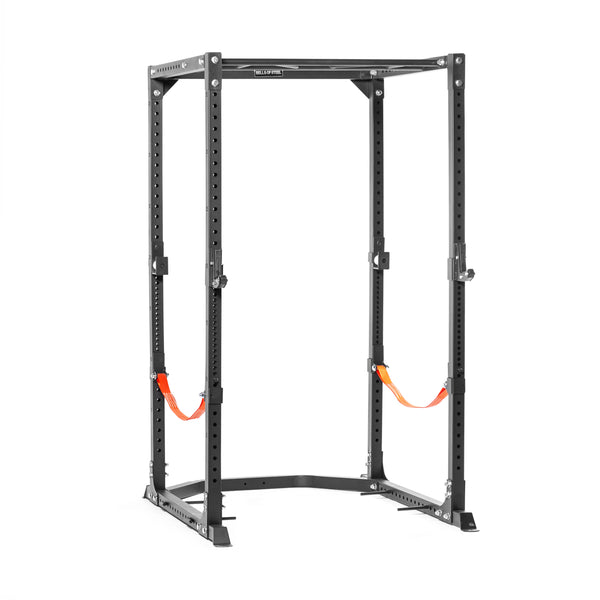
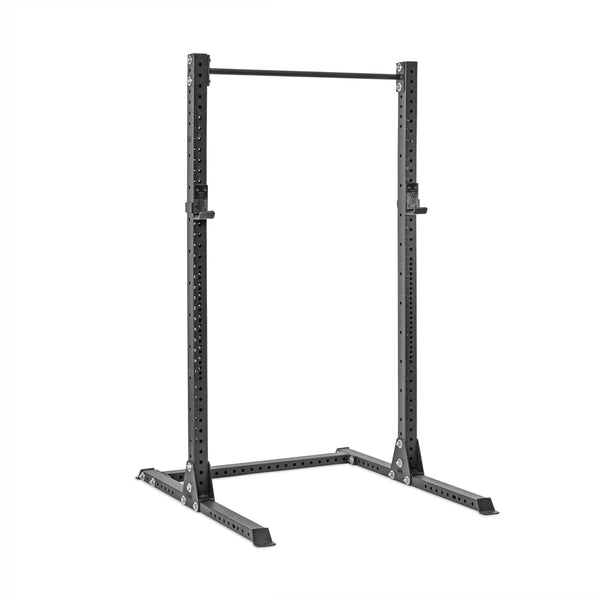
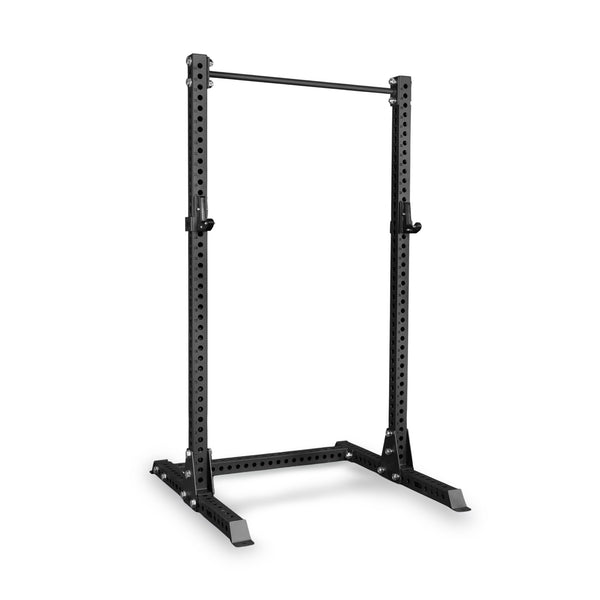
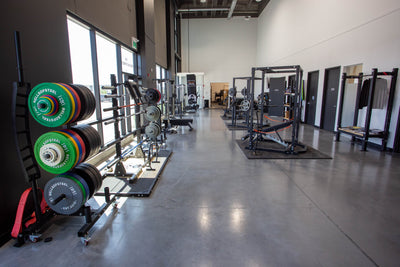
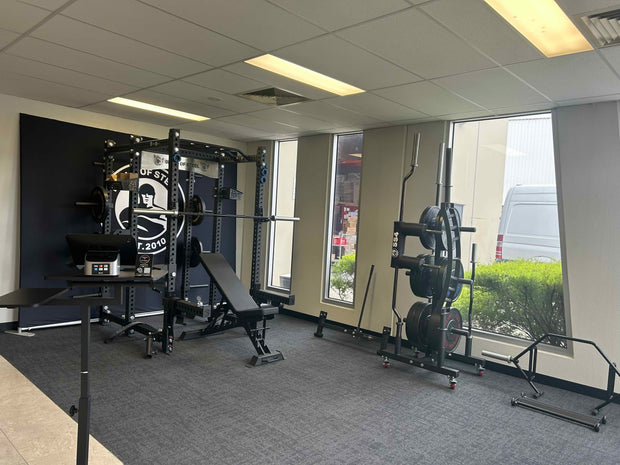
A power rack has four uprights and you lift inside it, with safeties on both sides. It's the safest pick for training alone. A squat rack (squat stands or a half rack) has two main uprights and you lift in front of it. It's smaller, cheaper and better for overhead work, but it catches less. A Smith machine locks the bar onto rails, trading free-weight freedom for a guided path. Most home gyms want a power rack or half rack first. A Smith is a great add-on, not a replacement.
Walk into any gym and ask what a "squat rack" is. You'll get four answers and one guy who just points at the cable machine.
That's the problem. Power rack, power cage, squat rack, squat stand, half rack, Smith machine: the names overlap, the listings mix them up, and the wrong pick costs you floor space, money, or a missed rep with nothing to catch the bar.
This guide sorts all four out. What each one is, how they compare on safety, footprint and versatility, and which one belongs in your gym.
Power rack vs squat rack vs half rack vs Smith machine at a glance
| Power rack | Half rack | Squat stands | Smith machine | |
|---|---|---|---|---|
| Also called | Power cage, squat cage, full rack | Squat rack, half cage | Squat rack, independent stands | Smith, guided bar |
| Uprights | 4 (or 6 with storage posts) | 2 main, plus rear base | 2, often separate | Rails on a frame or rack |
| Where you lift | Inside the frame | In front of the frame | Between the stands | Under a fixed bar path |
| Failing a rep solo | Best. Safeties on both sides | Good with spotter arms | Limited. Learn to bail. | Good. Bar can't drift. |
| Pull-ups | Yes | Usually | Depends on the model | Depends on frame |
| Attachments | The most | Plenty | Few | Frame-dependent |
| Footprint | Largest | Medium | Smallest, movable | Zero extra as a rack attachment |
| Cost | $$$ | $$ | $ | $ to $$$$ |
Now the details, one rack at a time.
What is a power rack?
A power rack is a steel cage with four uprights in a rectangle, joined by crossmembers. You step inside it to squat, bench and press, with safety straps or pin-and-pipe safeties set on both sides to catch a failed rep.
"Power cage" and "power rack" are the same thing. Some power racks add two rear posts for plate storage, which turns a four post into a six post.
Power rack pros
- Safest for training alone. Set the safeties just below your bottom position and a missed squat or bench becomes a non-event.
- Most versatile. Pull-ups, rack pulls, pin presses, dips, lever arms, lat pulldowns, even a Smith machine. Four uprights give attachments something solid to hang on.
- Most stable. More steel, bigger base, and plate storage adds even more weight at the back.
Power rack cons
- Biggest footprint. Plan for the rack plus room to load plates on both ends of the bar.
- Costs more. More steel, more money.
- Overhead pressing can get crowded. Tall lifters may press outside the rack or pick taller uprights.
On the budget end, the Residential Power Rack ships with pin pipe safeties and a pull-up bar and is designed to work without being bolted down. The Light Commercial Power Rack steps up to roller j-cups, safety straps, band pegs and a multi-grip pull-up bar. For a rack you can grow with, the Hydra Four Post Power Rack uses true 3" x 3" tubing and modular parts, and won Garage Gym Reviews' Best Squat Rack with Pull-Up Bar in 2024.
What is a squat rack?
Here's where it gets messy. "Squat rack" gets used for two different things:
- Squat stands: two uprights, sometimes joined at the base, sometimes fully separate. No roof, usually no pull-up bar.
- A half rack: two main uprights with a rear base or rear posts, plus a pull-up bar. More on that below.
Both work the same way: you rack the bar on j-cups and lift in front of the uprights, not inside a cage. Some people even call a full power rack a "squat rack." When you shop, ignore the label and count the uprights.
Squat rack pros
- Smaller and cheaper. Less steel means less money and less floor.
- Portable. The 2.3" Squat Stands have wheels on the back, so they roll aside when the car needs its spot back.
- Overhead freedom. Nothing above you, so presses and push presses lock out with room to spare.
Squat rack cons
- Less protection on a failed rep. No full-length safeties, so you need spotter arms, a spotter, or solid bailing skills.
- Fewer attachments. Two light uprights can't safely carry what four can.
- Separate stands can tip. Resting a heavy bar on spotter arms attached to independent stands can tip them. We've tested it on video, and we don't recommend it. If you go this route, bolt that bad boy!
If you want stands that act more like a rack, the Hydra Squat Stand joins both uprights to one base, adds a pull-up bar and carries a 1,000 lb capacity. Bolt it down before chasing chin-up PRs.
Still fuzzy on the naming? We broke it down further in are a squat rack and squat stand the same.
What is a half rack? (Half rack vs full rack)
A half rack sits right between squat stands and a power rack. Two main uprights up front, a base or short posts behind, and a pull-up bar across the top. You lift in front of it, with spotter arms out front to catch the bar.
Think of it as a power rack cut in half lengthwise. You keep most of the stability and attachment options and give back a chunk of floor.
| Half rack | Full power rack | |
|---|---|---|
| Safeties | Spotter arms in front | Safeties inside, on both sides |
| Footprint | Shallower and lighter | Deeper, more steel |
| Overhead pressing | Open above the bar path | Can be tight under the top crossmember |
| Attachments | Many | The most |
| Best for | Most garages and basements | Heavy solo training, attachment collectors |
The Hydra Half Rack carries a 1,000 lb capacity and expands into a bigger Hydra later with modular parts. Short on floor? The Manticore Folding Half Rack bolts to the wall and folds flat when you're done. More space-saving picks live in squat stands and specialty racks.
What is a Smith machine? (Smith machine vs power rack vs squat rack)
A Smith machine locks the barbell onto vertical guide rails. The bar can only travel up and down its track, so it can't drift forward, back, or sideways.
That changes the lift. You don't have to balance the bar, so your stabilizers do less work and you can focus on the target muscle. It also means the movement doesn't carry over one-to-one to a free-weight squat or bench.
Smith machine vs power rack
A power rack is for free-weight training with safeties as your backup. A Smith is for guided training where the rails are the backup. The power rack builds balance and full-body stability. The Smith lets you push close to failure on squats, presses and lunges with less setup and less wobble.
Smith machine vs squat rack
This one's closer than it looks. Squat stands give you total freedom and almost no protection. A Smith gives you protection and almost no freedom. If you train alone without a spotter and want to go hard on hypertrophy work, the Smith wins on peace of mind. If you want to squat the way meets and most programs expect, you want a bar on your back and nothing guiding it.
Why not both?
You don't have to pick. The Smith Machine Rack Attachment mounts to Hydra, Manticore and 84" Light Commercial racks (plus most 2.3" to 3" racks), so your power rack becomes a Smith without using another inch of floor. Run the built-in Smith bar, or bring your own barbell and use it on the rails. Want the whole package? The Kolossos combines a power rack, a fixed Smith bar rated to 600 lb and two 210 lb cable stacks in one frame.
Ignore the label on the listing. Count the uprights, then decide what catches the bar when you don't. Bells of Steel
Squat stand vs power rack: the 5 differences that matter
This is the most common home gym standoff, so here it is head-to-head.
1. Cost
Squat stands use far less steel, so they cost a lot less. A power rack's four uprights, crossmembers and thicker frame add up. See how much a power rack costs for the full breakdown.
2. Space
Our 2.3" stands are 29" long and 24" wide each and roll out of the way. A power rack is a permanent piece of furniture that stays where you put it.
3. Exercise versatility
Landmines, dip bars, lever arms and lat pulldowns need a stable frame. Power racks carry them. Squat stands mostly don't, or can't carry them safely.
4. Safety
Power rack safeties run front to back and set at dozens of heights, so you can train to failure alone. Squat stands rely on spotter arms, a human spotter, or dumping the bar. Details in are squat stands safe.
5. Storage
Six post power racks store plates on the rear posts, and most racks take storage attachments. Stands leave your plates on the floor or on a separate tree.
Bottom line: if all you need is a spot to rack the bar for squats and presses, stands do the job and save you money. If you want to dip, pull, rack pull, store plates and add attachments later, get the power rack. Wondering about the bench? Read can you bench on a squat stand first.
Is it safe to squat without a power rack?
When using squat stands: yes, if you know how to bail. Bailing means dumping the bar behind you when you can't stand up from the bottom of a squat. It's a skill, and like any skill, you practice it light before you need it heavy.
Your setup matters too. Bumper plates and rubber flooring absorb the drop. Iron plates on bare concrete are a great way to damage your bar, your plates and your floor all at once.
Bench is a different story. You can't bail a bench safely. If you bench heavy alone, use a power rack with safeties set just below your chest, or a half rack with spotter arms.
That being said, you need some form of uprights to properly load and unload barbell squats. Sure, in theory, you could do a barbell complex by cleaning and pressing the barbell overhead, then lowering it to your back to squat. But, most of us aren't superhuman, so.
Which rack should you buy?
You train alone and lift heavy
Get a power rack. Full-length safeties are the closest thing to a spotter who never cancels. Start with the Hydra Four Post or the Residential Power Rack.
You want the best balance of space, safety and versatility
Get a half rack. The Hydra Half Rack keeps pull-ups and attachments on the table and gives back floor space.
You share the garage with a car
Get squat stands or a folding rack. The 2.3" Squat Stands roll aside, and the Manticore Folding Half Rack folds flat to the wall.
You're building for hypertrophy or training a mixed household
Get a power rack and add the Smith Machine Rack Attachment. Free weights and guided work in one footprint.
Hydra racks use true 3" x 3" tubing with 5/8" holes. Manticore uses 3" x 3" with 1" holes and 5/8" keyholes. The Residential, Light Commercial and Squat Stands use 2.3" x 2.3" with 5/8" holes. Attachments are built for a specific tube and hole size, so match them before checking out.

Hydra Four Post Power Rack
True 3" x 3" tubing, modular build, and safeties on both sides. The award-winning power rack for heavy solo training.
Shop Power Rack
Hydra Half Rack
1,000 lb capacity, pull-up bar, and room to expand. Most of a power rack in less floor space.
Shop Half Rack
Squat Stands (2.3" x 2.3")
Compact, affordable, and wheeled at the back so they roll out of the way when the car comes home.
Shop Squat Stands
Smith Machine Rack Attachment
Turns your Hydra, Manticore or 84" Light Commercial rack into a Smith machine. No extra floor space.
Shop Smith AttachmentPower rack vs squat rack FAQ
What is the difference between a power rack and a squat rack?
A power rack has four uprights and you lift inside it, with safeties on both sides. A squat rack has two main uprights and you lift in front of it, so it's smaller and cheaper but catches less on a failed rep.
Is a power cage the same as a power rack?
Yes. Power cage, power rack, squat cage and full rack all describe the same four-upright frame.
Is a half rack as safe as a full power rack?
Close, but not quite. A half rack typically uses spotter arms out front, which work well when set correctly. A full power rack puts safeties on both sides of you, which leaves less room for error when benching or squatting heavy alone.
Is a Smith machine better than a squat rack?
It depends on your goal. A Smith machine is better for guided, stable training close to failure without a spotter. A squat rack is better for free-weight squats that build balance and carry over to sport and competition.
Can you add a Smith machine to a power rack?
Yes. The B.o.S. Smith Machine Rack Attachment fits Hydra, Manticore and 84" Light Commercial racks, plus most 2.3" to 3" racks, using the built-in Smith bar or your own barbell.
Do I need a power rack or are squat stands enough?
Squat stands are enough if you mainly squat and press and can bail safely. Choose a power rack if you train alone, bench heavy, or want pull-ups and attachments.
Can you use spotter arms on squat stands?
Not on light, separate stands. A heavy bar resting on spotter arms can tip independent stands over. Joined-base stands like the Hydra Squat Stand are more stable, and bolting them down helps.
Which takes up less space, a half rack or a power rack?
A half rack. It gives up the rear half of the cage. Squat stands take even less, and folding racks can fold flat to the wall.
Does a power rack have to be bolted down?
Not always. Flat-foot racks like the Residential Power Rack are designed to work without bolting. Read do power racks have to be bolted down for the full checklist.
Still torn? Send the B.o.S. support team your space and training goals and they'll help you pick. Building out the rest of the gym? Browse Hydra racks, squat stands and specialty racks, or rack attachments.