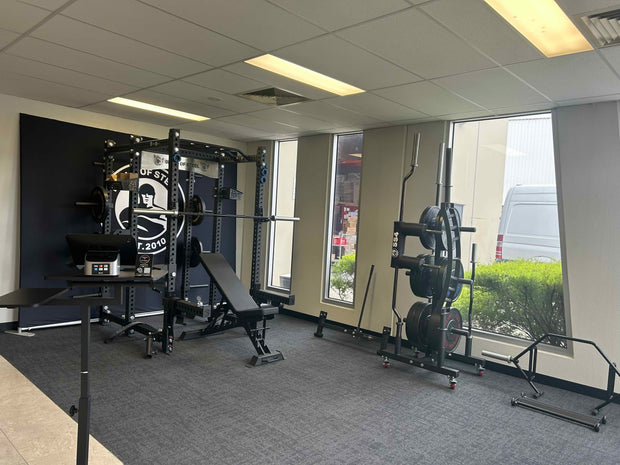
Weight plates seem simple enough. Round, heavy, hole in the middle. Done, right?
Not quite. Once you start building a home gym, the questions pile up faster than plates on a deadlift bar. Can bumpers and iron plates share a barbell? Are calibrated plates worth the splurge? Do 35s deserve a spot on your rack?
These are the questions the B.o.S. team hears constantly, so here are the straight answers, all in one place.
Can You Mix Bumper Plates and Iron Plates?
Yes, with one big asterisk. It all comes down to what you're doing with the bar.
For standard strength training, mixing bumper plates and iron plates works just fine. Deadlifts, presses, squats, any lift where the bar comes down under control, go ahead and load whatever combination you've got. When you set the bar down gently, the bumper still makes contact with the floor and there's not enough force involved to cause trouble.
Olympic lifting is a different story. Snatches and clean and jerks are dynamic lifts where the bar gets dropped from height, and that's where the mixed setup falls apart.
Why Dropping a Mixed Bar Is a Bad Idea
Here's the problem: a bumper plate has a slightly bigger diameter than an iron plate. When a mixed bar slams into the ground, that size difference means the impact doesn't get absorbed the way it should.
Three bad things can happen. The bar can bend, your bumper plates can get damaged, and your floor loses the protection a bumper is supposed to provide. That's a lot of expensive consequences for one dropped rep.
So if your training involves slamming the bar down, stick to bumpers only. Your barbell, your plates, and your flooring will all thank you.
The Right Way to Load a Mixed Bar
If you are mixing plates for controlled lifts, loading order matters. Put the bumper plate on the inside, closest to the bar's collar. Then add your iron plates, followed by your change plates on the outside.
This keeps the bumper doing what it does best, absorbing contact with the ground, while the smaller plates stay safely out of the way.
Are Calibrated Plates Worth It for a Home Gym?
Honest answer: no, not for most people.
Here's a fun fact that surprises a lot of lifters. Most of the plates at commercial gyms aren't calibrated either. There are slight weight variations between almost all plates, and that includes B.o.S. bumpers, iron plates, and even the calibrated line when compared against each other.
Calibrated plates exist for one specific purpose: competition prep. If you're training for a powerlifting meet, calibrated plates let you keep every session exact, so the weight on the bar matches what you'll face on the platform down to the gram.
For everyone else, that precision is overkill. A plate that's off by a few ounces isn't going to slow down your gains. Save the money and put it toward more weight instead.
Do You Actually Need 35 lb Plates?
This one sparks debate, but the practical answer is no.
Most lifters skip the 35 and grab a 25 and a 10 instead. Same total weight, way more versatility. That pair can load a bar as 35, but it can also work as a standalone 25 or 10 for other lifts, warm-ups, and accessories.
There are two more strikes against the 35. First, it eats up storage space and tends to crowd out your 45 lb plates, the ones you're reaching for all the time. Second, it makes bar math annoying. Counting up in 45s, 25s, 10s, and 5s is quick and clean. Toss a 35 into the mix and suddenly you're doing algebra between sets.
Nobody signed up for algebra between sets.
The Best Starter Plate Set Combo
Ready for the ideal starting lineup? Here's the plate set combo that covers the widest range without wasting a dollar:
- One pair of 45 lb plates
- One pair of 25 lb plates
- Two pairs of 10 lb plates
- One pair of 5 lb plates
- One pair of 2.5 lb plates
This setup gives you clean 5 lb increments all the way from 45 lbs up to 240 lbs, bar included. That's enough range to carry a beginner through months, sometimes years, of steady progress without ever getting stuck between jumps.
How to Expand Your Set as You Get Stronger
The beauty of the starter combo is that upgrading is dead simple. Once you're an intermediate or advanced lifter and 240 lbs stops being a ceiling, just keep adding pairs of 45 lb plates.
No need to rethink the whole collection or buy odd sizes. The small plates you already own handle every increment, and the extra 45s push your top end higher. Stack, lift, repeat.
The Bottom Line on Weight Plates
Quick recap for the skimmers: mix bumpers and iron plates for controlled lifts but never for bar drops, keep the bumper on the inside, skip calibrated plates unless you're competing, choose a 25 and a 10 over a 35, and start with the 45/25/10/10/5/2.5 combo.
When you're ready to build (or grow) your set, the full weight plates lineup at Bells of Steel has everything from 2.5s to competition bumpers. 💪